
The Forgotten Powerhouse is the reference for identifying, restoring, and maintaining a vintage DeWalt, Delta, or Craftsman radial arm saw, whether you inherited one, found one at an estate sale, or just dragged one out of a barn. Full brand-by-brand model reference, a complete restoration walkthrough, and a hard look at where this saw's "death trap" reputation actually came from.
Written for anyone who has inherited a radial arm saw, found one at an estate sale, or had one sitting in the garage for years and never felt confident using it fully. No prior experience with the tool required.
Notify Me at Launch ↓Four passages from The Forgotten Powerhouse, straight from the book.
Restoring a vintage radial arm saw is one of the most satisfying tool restoration projects there is. A machine that has sat neglected in a barn or basement for twenty or thirty years, covered in rust and sawdust, can be returned to better-than-new performance with patience, the right tools, and a systematic approach.
This chapter provides a comprehensive restoration guide applicable to most vintage radial arm saws, with notes on brand-specific considerations for DeWalt, Delta, and Craftsman machines.
DeWalt was not the first to patent a saw that hangs over the work and travels on an arm. In 1912 the U.S. Patent Office granted No. 1,014,708, "Sawing-Machine," to Mackintosh Hutchinson of Toronto, Ontario. He had filed it on April 24, 1911. Its drawings show an upright post, a sliding frame, horizontal beams, and a bracket that slides along them and carries the saw over the work. The motor sits on the bed plate, and two belts carry its power to the saw shaft.
Raymond Elmer DeWalt patented a radial saw with the motor mounted directly on the saw arbor. According to DeWalt's history, the idea came to him in 1922. DeWalt had followed his father into mill and construction work, and the cost of labor always bothered him. DeWalt's company history, as it stood in 2008, says he was offered the job of heading a woodworking mill that made everything from boxes to houses. There was more work than the men could do, and the company president would not allow a larger payroll. The same history calls him the superintendent of Seabrook Farms in 1922. He designed a yoke, attached it directly to a motor and saw, and mounted it on a standard arm. The saw could be raised, lowered, slid back and forth, moved to any angle or tilted to any bevel, and DeWalt says it did the work of four men. His idea was simple. Instead of pushing wood past a stationary blade, the blade would travel on an arm over a stationary table. The saw head could be pulled through the workpiece to crosscut it. The arm could swing to make angled cuts, and the motor could tilt in its yoke to make bevel cuts.
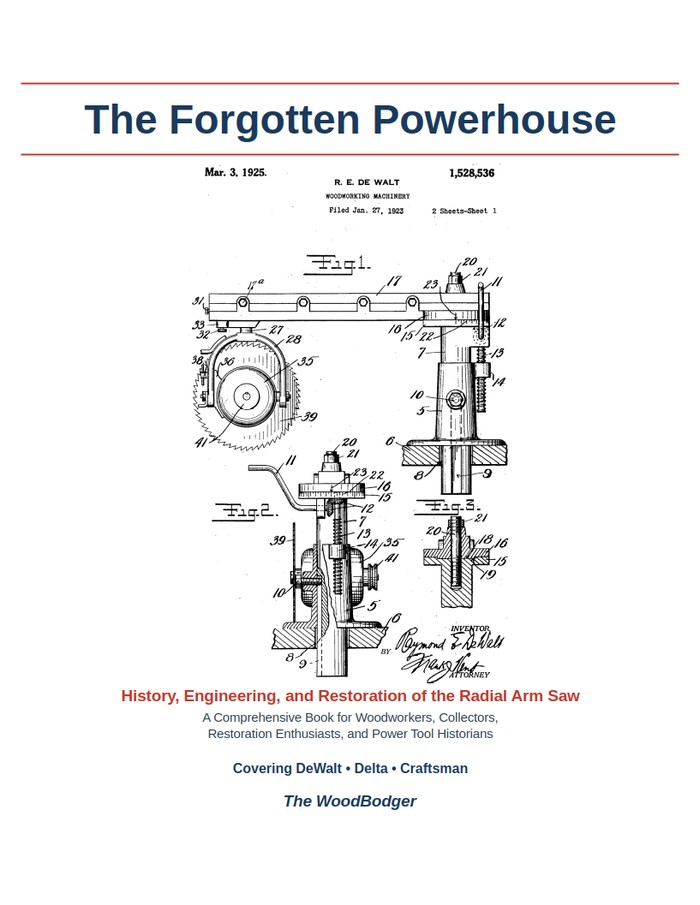
DeWalt filed his patent application on January 27, 1923. It was the second of ten patents he filed, the first dating to September 1921, according to DeWalt's history page. The patent was granted on March 3, 1925, as U.S. Patent No. 1,528,536, "Woodworking Machinery." The claims describe a vertically adjustable post, a horizontal arm pivoted on the top of the post, a carriage that slides along the arm, a yoke hanging from the carriage, and a motor that pivots in the yoke. The complete patent drawings and specifications are reproduced in Appendix B. They are also available through Google Patents, the USPTO Full-Text database and DATAMP.
Woodworking shouldn't be a "rich man's game." One of the biggest barriers to the craft is the skyrocketing cost of lumber. The WoodBodger approach looks at the waste stream as a primary resource.
Recycling wood, whether it's old floor joists, salvaged barn beams, or discarded shipping pallets, is the ultimate way to keep projects affordable.
Traditionally, a "bodger" was a woodworker who worked in the woods, using simple tools and ingenious methods to create high-quality chair legs and parts. They were masters of making do with what was at hand. The WoodBodger project applies that same spirit to the modern shop.
Nobody has shown that the radial arm saw is dangerous as a category. The evidence usually offered against it is a large recall of Craftsman saws in 2000, one lawsuit, and a small body of injury data. I have found nothing that explains how the saw's reputation formed. Those Craftsman saws had been off the market for years by the time of the recall: the 113-series models were sold through 1992, and the 8¼-inch model through 1995. Even so, the reputation settled on every radial arm saw ever built, whatever the brand and whatever the condition.
A World War II era promotional film for DeWalt power saws, showing them cutting lumber for training bases, barracks, drill halls and shipyard construction. Posted on the Internet Archive by PeriscopeFilm. The film runs about 25 minutes.
Radial arm saws have no wooden handles and no cast iron tables to hide behind. Their surfaces are bare metal castings, painted components, and exposed hardware. That's part of what makes them intimidating, and part of what makes proper restoration and care so important.
Step-by-step guidance for bringing a neglected saw back to safe, accurate, dependable service, with full restoration walkthroughs from teardown to first cut.
Ongoing care: lubrication, corrosion prevention, finish protection, and alignment, plus tune-up guidance so the work sticks.
Where the radial arm saw came from, how it became a home-shop staple, and how its reputation curdled over the decades: the real history behind the "death trap" myth.
Yes. It's written for anyone who owns or has found a radial arm saw and wants to use it with confidence, whether that's your first power tool or your fiftieth. No prior experience with this specific tool is assumed.
Brand-specific guidance covers DeWalt, Delta, and Craftsman radial arm saws in depth, alongside restoration and maintenance principles that apply across brands and eras.
The current plan is a spiral-bound, lay-flat workshop edition at launch, with a digital edition to follow for anyone who'd rather read on a screen. That order could still change before launch.
The book is in late-stage editing now. Leave your email and I'll let you know the moment it's ready to order. No spam, just one note when the book launches.
Prefer not to leave an email? You can also just reach out directly and I'll add you to the list myself.
Clicking "Notify Me" opens your email client with your name and email ready to send. I'll add you to the list personally.
While the book finishes editing, take a look at the rocking chairs and woodturnings coming out of my shop right now.
View the Galleries →